Espiritualidad y psicoterapia · Artículo 5
The God That Gave You Sunglasses
How fear, belonging and the need for love can shape our experience of the sacred. An essay introducing the nine religious lenses — a reflective framework by Oscar Rivas for understanding the image of God we carry.

Oscar Rivas, PhD
· 15 min de lectura

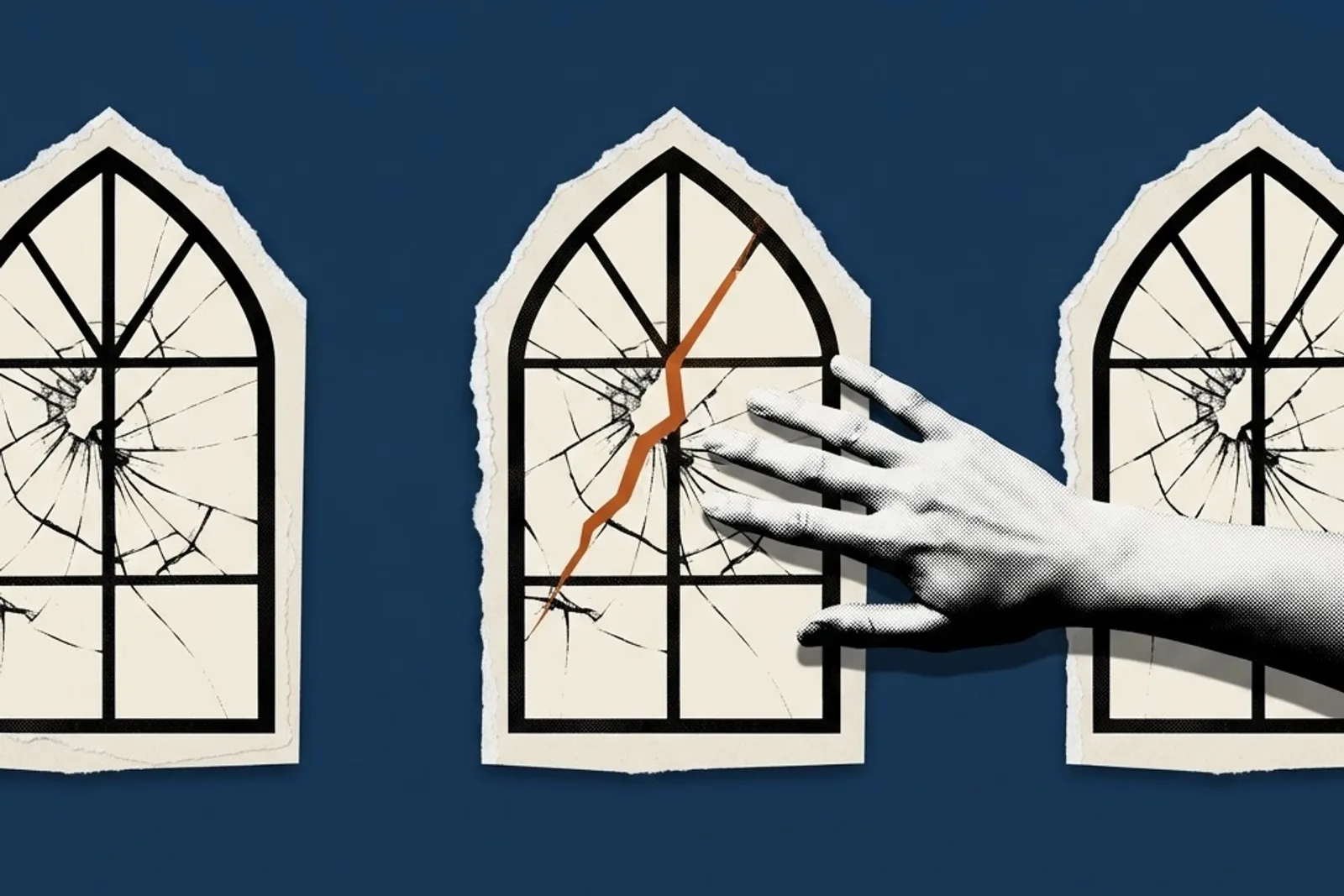
Imagine a boy who grows up in his father’s stained-glass workshop. In the afternoons, patches of red and blue travel across the floor. He likes to stand inside them and watch his hands change colour.
One night, a storm breaks a large window. His father finds him crying among the fallen pieces. The boy is unharmed, but afterwards his father cannot look at the bright glass without remembering how close his son came to being hurt.
In this small, invented story, the father makes the child a pair of sunglasses from the darkest glass he can find. He tells him to keep them on. “They will help you see the world safely.”
The boy trusts him. Through the lenses, even clear mornings look as though rain is coming. Other children seem careless when they run outside. He wonders why nobody else notices how threatening the sky looks.
Years pass. He forgets the colour of the workshop before the storm. He still loves his father. He still wears the glasses. Eventually, he begins to pray for a brighter sky.
The lenses we inherit
I think of this story when considering the images of God we carry. We inherit teachings and prayers, but also tones of voice, habits of obedience and expectations about what happens when we disappoint someone. These can become so familiar that we barely notice them. They seem to describe the world itself.
A person may sincerely believe that God is loving while feeling unable to rest in that love. Another may speak about forgiveness and still expect every mistake to bring punishment. Someone else may find kindness easier to imagine from a stranger than from the God they worship. Those contradictions deserve patient attention. They are where I begin with the framework I call the nine religious lenses.
A lens directs attention. It makes certain details stand out and leaves others difficult to see. Through one lens, a request sounds like an obligation. Through another, disagreement sounds like abandonment. In religious life, a lens may shape what we expect from God, how much we trust ourselves and whom we consider safe.
The broader relationship between trauma and spirituality does have a research base. The US National Center for PTSD describes how faith can offer comfort and support after trauma, while experiences of divine abandonment, punishment or religious conflict can accompany greater distress. It also acknowledges limits in the evidence, including the concentration on Christian populations in the United States and studies that capture only one moment in time. Those findings leave considerable room for questions about cause, culture and individual differences. They do not validate this nine-lens framework.
My proposal is that some religious expectations may become easier to understand when we ask what a person has learned about love, danger and belonging. Someone who received attention chiefly when useful might struggle to imagine being loved while doing nothing. A person accustomed to unpredictable anger might find the idea of constant divine observation frightening. These are possibilities to explore with the person, never histories to assign to them.
Religion can also interrupt those expectations. A community may be the first place someone receives reliable care. For another person, the religious community itself may be where fear and coercion began. Childhood is only one part of the story; present relationships and institutions matter too.
What we expect from God
The Foreman God
What it restores: Grace
The Sentinel God
What it restores: Safety
The Painkiller God
What it restores: Presence
What we trust in ourselves
The Nanny God
What it restores: Agency
The God Who Hates Questions
What it restores: Curiosity
The God Disgusted by the Body
What it restores: Embodied dignity
Who we consider safe
The God of Us
What it restores: Belonging with freedom
The God of the Pure
What it restores: Dignity
The General God
What it restores: Grounded agency
The nine lenses fall into three families. Three shape what we expect from God (the Foreman, Sentinel and Painkiller God); three shape what we come to distrust in ourselves (the Nanny God, the God Who Hates Questions, the God Disgusted by the Body); and three shape whom we are allowed to consider safe (the God of Us, the God of the Pure, the General God). Each lens is paired with the word that names what would restore it — grace, safety, presence, agency, curiosity, embodied dignity, belonging with freedom, dignity and grounded agency.
What we expect from God
The Foreman God
Through this lens, love appears to depend on usefulness. There is always another task, another sacrifice, another way to prove commitment. Imagine a church volunteer who agrees to organise one more event despite being exhausted. Nobody has explicitly threatened to reject her. Yet when she considers declining, she feels she is becoming selfish. Her calendar fills because an empty evening seems morally difficult to defend.
Her service may be generous and meaningful. The question is what happens when she reaches a limit. Can she remain a valued member of the community when someone else must carry the chairs? Grace becomes tangible in that moment: she says she cannot help, and the relationship survives. “I can rest without losing my worth” becomes something she has experienced, however briefly. If this lens is connected to a history of conditional affection, such an experience may matter. The history still has to be heard in her own words.
The Sentinel God
The Sentinel God makes safety depend on staying alert. A forgotten prayer, an unwanted thought or an ordinary setback can seem to require investigation. What have I done? What have I missed? A hypothetical Catholic believer might repeatedly revisit a confession, searching for the detail that could make it incomplete. An evangelical believer might read a broken appliance or a delayed journey as evidence of divine displeasure. These examples describe possible experiences within those settings, not characteristics of the traditions themselves.
For someone who has known unpredictable punishment, this vigilance may feel familiar. Others may develop similar habits through frightening instruction or difficulties that need their own assessment. Repeated checking is not proof of trauma. The word I associate with this lens is safety. It raises a practical question: what would help this person feel safe enough to stop checking? When checking becomes persistent and disruptive, a qualified clinician can help assess it.
The Painkiller God
With the Painkiller God, the difficulty is allowing suffering to remain unresolved. A loss must quickly acquire a purpose. Anger must become forgiveness. Sadness needs to sound grateful before anyone has had time to listen. Picture someone returning to a faith community after a bereavement. Friends offer sincere explanations about God’s plan. The person nods because there seems to be no acceptable answer to kindness that makes them feel more alone.
Spiritual meaning can be deeply sustaining. Timing and freedom matter. A grieving person needs room to discover what helps, including the possibility that no explanation helps today. In a hypothetical Buddhist setting, an appeal to impermanence could similarly be used to end a conversation about grief before the grieving person feels heard. Here, I use the word presence. Someone brings food, remembers the name of the person who died and tolerates an unfinished conversation. “My pain is welcome here” begins to sound possible. No one requires a lesson from it.
What we come to distrust in ourselves
Other lenses turn our attention inward, making our own judgement, questions or bodily experience seem unreliable.
The Nanny God
The Nanny God offers the relief of having someone else decide. Advice gradually becomes permission. A person may feel unable to accept a job, begin a relationship or change a routine without a spiritual authority’s approval. There are good reasons to seek guidance. The difficulty arises when guidance leaves someone less able to choose.
A useful question is whether, over time, the relationship makes room for disagreement and responsibility. Can the person weigh advice, reach a different conclusion and still be treated with respect? Agency grows through opportunities to choose and to live with imperfect decisions. “I can receive guidance and still make my own choices” leaves room for humility, consequences and learning. It also leaves room for the adviser to have limits.
The God Who Hates Questions
The God Who Hates Questions makes inquiry feel dangerous to the relationship. A person may know exactly what they want to ask and spend the whole meeting trying to make the question sound harmless. Consider a student in a Buddhist community who raises a concern about a teacher’s conduct. Suppose the response is that the student’s ego is resisting instruction. Their concern has been turned into evidence against their capacity to judge. A similar move can happen when a Christian’s question is dismissed as pride or lack of faith.
These are hypothetical uses of authority. Applying the framework in Buddhist settings requires particular care: many Buddhist traditions do not centre a creator God. There, the relevant question concerns how teachers, teachings or spiritual ideals are experienced. Whether the same lens categories fit across traditions remains something to investigate. Curiosity needs more than an invitation to ask questions. It needs a response that makes asking worthwhile. A leader who can say, “I do not know,” or, “You are right to ask about that,” gives the relationship room to develop.
The God Disgusted by the Body
The God Disgusted by the Body makes bodily experience itself feel like evidence of unworthiness. Desire becomes a reason for shame. Tiredness suggests weakness. A need for comfort seems embarrassing to admit. Imagine someone sitting through a spiritual practice in pain because adjusting their posture would feel like failure. Or someone who treats an unchosen feeling of attraction as a verdict on their character. What troubles me in these examples is the loss of space between noticing an experience and condemning the person having it.
I call the alternative embodied dignity. It allows someone to notice hunger, fatigue, pleasure or discomfort and then decide how to respond. Consent and responsibility remain essential. A feeling does not dictate an action, but having a feeling does not remove anyone’s worth.
The body belongs in this conversation without becoming a diagnostic shortcut. Heightened alertness, a pounding heart, numbness and avoidance can occur after trauma. None of them, on its own, tells us why a particular person is distressed or which religious lens they use. Bodily discomfort deserves attention; it cannot, by itself, decide whether a situation is unsafe or an action is wrong.
Who we are allowed to consider safe
The remaining lenses concern other people. They ask what happens to belonging when someone is different, disagrees or leaves.
The God of Us
Through the God of Us, the right group becomes the condition of safety. Imagine someone who finds deep friendship in a congregation, then begins concealing an outside friendship because others might question their loyalty. Over time, ordinary decisions require an audience in their head. They rehearse what the group would think before noticing what they think themselves.
Belonging has real value, especially for someone who has known isolation. There may also be real costs to dissent, including the loss of practical support. Telling that person simply to speak up overlooks the situation they must live with afterwards. Belonging with freedom would allow them to maintain other relationships and disclose disagreement without having their entire place in the community put at risk. “I can belong without disappearing” is a standard by which a community can examine its own behaviour.
The God of the Pure
The God of the Pure adds the fear that contact with certain people can diminish our acceptability. A family member’s sexuality, someone’s religious background or a person’s public struggles may become a reason to keep them at a distance. Suppose a family stops inviting a gay relative to ordinary gatherings because they believe hospitality would compromise their holiness. The exclusion is concrete: a chair is missing at the table. Understanding the family’s fear might help explain their reasoning. It does not undo what they have done to their relative.
The word dignity asks us to reconsider who is being made to carry the cost of another person’s need to feel pure. Boundaries can respond to harmful behaviour without treating someone’s identity or difference as contamination. This lens, like the others, gives us no basis for inferring an undisclosed trauma.
The General God
The General God makes conflict feel like a permanent assignment. Disagreement becomes an attack on everything that matters. A critic must be defeated before their claim can be considered. In an imagined congregation, a member asks for an independent investigation of a leader. Other members describe the request as an assault on the faith. Loyalty now appears to require defending the leader, even when doing so obstructs the truth.
Here, grounded agency means recovering the ability to respond proportionately, examine evidence and protect people. It can include firm opposition to abuse and a willingness to act. “I can stand firm without making you my enemy” leaves room for accountability without requiring dehumanisation.
The abuse of conscience
These lenses become especially consequential when they are enforced. A private fear can become an institutional expectation: members must keep serving, stop questioning or protect the group’s reputation at personal cost.
I use the term abuse of conscience for the coercive use of sacred or moral authority to undermine a person’s freedom to examine, judge and choose. Someone’s capacity to refuse may be recast as rebellion against God. Reporting harm may be treated as disloyalty. Their distress may be used to discredit what they are reporting.
This is a proposed way of naming a problem, rather than a clinical diagnosis. Its focus is the use of power. A leader can challenge someone, teach demanding commitments or disagree with a decision while respecting that person’s freedom. Coercion becomes visible in what follows refusal: threats, humiliation, retaliation or the withdrawal of essential support.
Conscience also involves responsibility. Listening to oneself includes examining evidence, recognising other people’s rights and accepting correction. The freedom at stake is the freedom to participate honestly in that process, including when the conclusion displeases an authority.
Understanding someone’s vulnerability never transfers responsibility for abuse to them. A person’s fear of rejection does not cause another person to exploit it.
Likewise, whatever wounds an abusive leader may carry, the leader remains responsible for their conduct. Communities have responsibilities too, including protecting those who report harm and making accountability possible.
Where to begin
For a reader who recognises something here, it may help to begin with one ordinary situation. Think of the next request you expect to receive, or a question you have been postponing. What do you anticipate would happen if you answered honestly? How much of that expectation comes from experience with the people involved?
Sometimes the answer reveals an old fear in a relationship that can accommodate change. Sometimes it reveals a present danger that needs practical support. The distinction matters before anyone asks you to become more trusting.
Words such as grace, safety, presence and dignity can give direction, but they need to become credible in daily life. Rest has to be allowed. A question has to receive a fair hearing. Someone needs to stay in the room when grief becomes inconvenient. Where distress is persistent or interferes with daily life, professional support can make space to examine it without forcing a religious conclusion.
Some people will do this work within their faith. Others will leave a community or a tradition. Many will need time before they can say what they believe. The nine lenses should leave that decision with the person using them. If the framework becomes another way to tell people what their experience must mean, it has failed its purpose.
In the story, the boy grows into a man who repairs his glasses whenever the frames wear out. One day, a woman restoring a window notices how dark the lenses are. She asks whether he remembers who made them. He tells her about his father and the storm. Then he asks whether she knows how to make the sky brighter.
She brings two chairs into the shade. He lifts the glasses a little, looks towards the garden and lowers them again. His eyes water. She stays beside him. There is no need for him to settle everything about his father that afternoon. He can remember the care and question the instruction. For a while, he holds the glasses in his hand.
And for those of us whose questions still include God, there is something worth asking while we sit there: when you imagine being fully known by God, what do you expect to happen?
Referencias
- U.S. Department of Veterans Affairs, National Center for PTSD. Addressing Religious or Spiritual Dimensions of Trauma and PTSD. https://www.ptsd.va.gov/professional/treat/txessentials/spirituality_trauma.asp
- U.S. Department of Veterans Affairs, National Center for PTSD. Common Reactions After Trauma. https://www.ptsd.va.gov/understand/isitptsd/common_reactions.asp
- Pargament, K. I. (1997). The Psychology of Religion and Coping: Theory, Research, Practice. Guilford Press.
- Winnicott, D. W. (1965). The Maturational Processes and the Facilitating Environment. Hogarth Press.
Conceptos clave
- The nine religious lenses
- A framework Oscar Rivas is developing for reflection and research: nine recurring ways in which expectations about love, danger and belonging shape a person’s experience of God. The lenses can overlap or fail to describe someone; they are not a validated psychological assessment.
- A religious lens
- A habitual way of directing attention that makes certain features of the sacred stand out and leaves others hard to see — shaping what a person expects from God, how much they trust themselves and whom they consider safe.
- The Foreman God
- A lens through which love appears to depend on usefulness: there is always another task or sacrifice needed to prove one’s worth. Its restorative word is grace — the experience that one can rest without losing worth.
- The Sentinel God
- A lens through which safety depends on staying alert: an ordinary setback can seem to demand investigation of what one did wrong. Its restorative word is safety.
- Abuse of conscience
- A proposed name for the coercive use of sacred or moral authority to undermine a person’s freedom to examine, judge and choose. It is visible in what follows refusal: threats, humiliation, retaliation or the withdrawal of essential support. It is not a clinical diagnosis.
Preguntas frecuentes
What are the nine religious lenses?
They are a framework Oscar Rivas is developing to describe nine recurring ways that expectations about love, danger and belonging shape how a person experiences God. Three concern what we expect from God, three what we come to distrust in ourselves, and three whom we are allowed to consider safe. They are meant for reflection, not for diagnosis.
Does recognising a lens mean a person has been traumatised?
No. The lenses are not a validated assessment and no lens reveals a specific event in someone’s past. A religious expectation can form through frightening instruction, present relationships or difficulties that need their own explanation. Recognising a lens is an invitation to ask questions with a person, never a history to assign to them.
What is the Foreman God?
It is the lens through which love appears to depend on usefulness — there is always another task, sacrifice or way to prove commitment. Grace becomes tangible in the moment a person says they cannot help and the relationship survives: “I can rest without losing my worth” becomes something they have experienced.
What is the abuse of conscience?
It is the coercive use of sacred or moral authority to undermine a person’s freedom to examine, judge and choose. A leader can challenge someone or disagree with a decision while respecting their freedom; coercion becomes visible in what follows refusal — threats, humiliation, retaliation or the withdrawal of essential support. Understanding a person’s vulnerability never transfers responsibility for abuse to them.
Can faith help after trauma?
It can. The US National Center for PTSD describes how faith can offer comfort and support after trauma, while experiences of divine abandonment, punishment or religious conflict can accompany greater distress. The evidence has limits and does not validate this framework; where distress is persistent, professional support can help examine it without forcing a religious conclusion.
- english
- religious lenses
- image of God
- abuse of conscience
- spirituality
- trauma